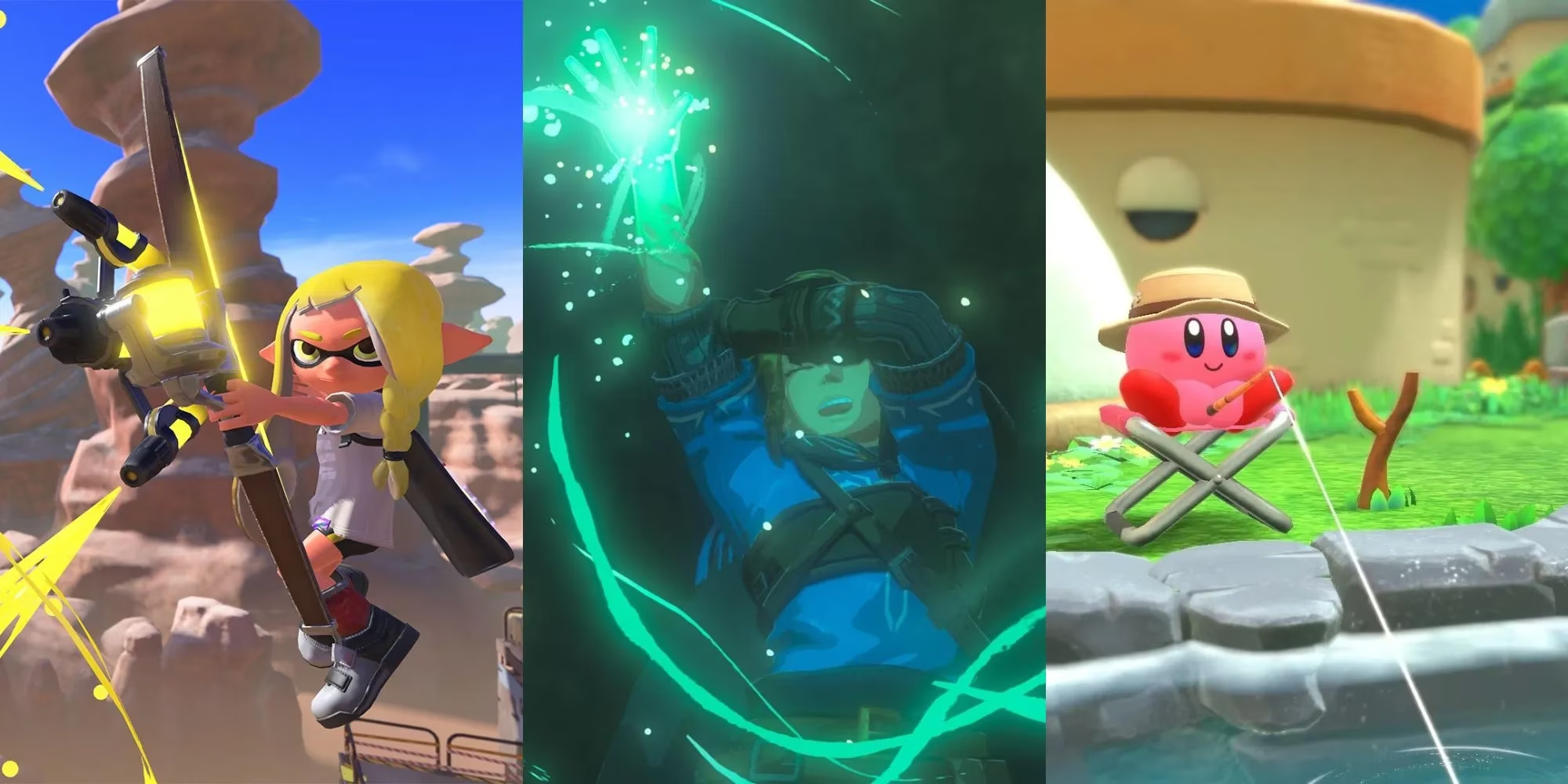
I still remember staring at that image back in March 2022—the one with a montage of Zelda, Kirby, Splatoon, and so many other games—wondering if Nintendo could really pull off a year that stacked. The sequel to Breath of the Wild was the hazy dream on every Switch owner’s mind, but the present was already bursting with Pokémon Legends: Arceus, Kirby and the Forgotten Land, and announcements that made my head spin. Now, here I am in 2026, and it’s almost laughable how that year was merely a warm-up. Don’t get me wrong—Tears of the Kingdom (as we eventually came to call it) shattered every expectation when it finally landed in 2023, and its construction mechanics are still the benchmark for creative freedom. But if 2022 taught me anything, it’s that Nintendo’s magic doesn’t live or die with one Zelda game. As I look at the current release calendar and the whispers of what’s next, I can’t help thinking: have we ever had it this good?
The past few years turned the Switch from a scrappy hybrid into a cultural juggernaut, and with the Switch 2 now in its second full calendar year, the momentum is bewildering. First-party output in 2026 alone reads like a wishlist I would have scribbled in my high school notebook. Metroid Prime 4 finally arrived last holiday, and honestly, did any of us think we’d be scanning alien flora in 4K at 60 frames per second on a Nintendo handheld? That game’s development saga became a meme, but Retro Studios delivered an atmospheric masterpiece that simultaneously honored the Prime trilogy and pushed the series into genuinely terrifying territory. It isn’t just Samus carrying the core lineup, though. A new 3D Mario is rumored for the fall—an open-world follow-up to Odyssey that supposedly lets us travel between kingdoms in a seamless Mushroom World. After Bowser’s Fury teased that concept, is it really so hard to believe? Add Mario Kart 9 with its dynamic track transformations and the long-awaited return of a proper single-player campaign (did anyone else cry when they teased a story mode?), and it’s clear Nintendo is redefining even its most comfortable franchises.
Meanwhile, the stable of role-playing and tactics experiences that I fell in love with in 2022 has only deepened. I still grin remembering how Triangle Strategy gave me Game of Thrones vibes in chibi form, and how Xenoblade Chronicles 3’s massive parties and heart-wrenching narrative cemented Monolith Soft as the studio that just gets melodramatic sci-fi. Now, in 2026, we’re about to get Xenoblade Warriors, a musou crossover that drags Shulk, Noah, and Elma into a timeline-collapsing brawl—because who doesn’t want to see the Monado cleave through hundreds of Mechon while Keves and Agnus soldiers team up? And then there’s Pokémon Legends: Z-A, which launched in early 2026 and turned Lumiose City into a sprawling, vertically layered ecosystem where every alleyway hides a new evolution of the catching mechanics that Arceus pioneered. The fact that Game Freak managed to make a single metropolis feel as vast as Hisui still boggles my mind, and it proves the company listened when fans pleaded for more seamless, ambitious worlds after Scarlet and Violet.
But here’s the thing that really makes 2026 special: Nintendo’s approach to its back catalog has evolved from simple emulation into a full-blown celebration of forgotten gems. The NSO subscription tiers now include GameCube games—yes, F-Zero GX and Paper Mario: The Thousand-Year Door run natively on my Switch 2, with online leaderboards. The remake pipeline, too, continues the trend that Live A Live and Advance Wars 1+2 Re-Boot Camp started. This June brings an HD-2D overhaul of Mother 3, finally localized for the West after decades of requests. I never thought I’d see the day when I could play Lucas’s full journey on official hardware, with the same painterly visuals that turned Octopath Traveler into a love letter to the Super NES era. And speaking of love letters, The Legend of Zelda: Wind Waker and Twilight Princess received native ports with quality-of-life upgrades—no more tedious Triforce shard hunts unless you choose to play the original mode. These rereleases aren’t just nostalgia bait; they’re statements that even the company’s strangest experiments deserve preservation.
Third-party support, which often felt like a cautious dance back in 2022, has exploded into a full partnership. Remember when Portal: Companion Collection and The Ezio Collection felt like big gets? Now I’m playing Elden Ring on my morning commute with gyro aiming that actually works, and Final Fantasy VII Remake Intergrade looks shockingly close to the PS5 version thanks to the Switch 2’s DLSS-like magic. Sonic Frontiers 2 launched day-and-date with other platforms this spring, and its open-zone chaos runs at a rock-solid framerate. Even niche titles like Outer Wilds have found a second life here, the game’s time-loop melancholy feeling right at home on a device I can curl up with in bed. Ubisoft continues to cozy up to the platform too—Mario + Rabbids Sparks of Hope got a massive free expansion that added procedural galaxy exploration, and leaks suggest a third crossover might be in early development. These aren’t just ports; they’re full-throated endorsements of a hybrid ecosystem that no longer feels like a compromise.
So when I think back to that 2022 article that had me questioning whether the Breath of the Wild sequel would even make it that year, I chuckle. That game arrived, blew minds, and the industry moved on—but Nintendo didn’t slow down. It used the momentum to launch new hardware, revive dormant icons, and treat its history with the respect it deserves. What’s left to wonder? Maybe just this: if 2022 was the year of setting the stage, and 2023 was the year of the masterpiece, what does that make 2026? From where I’m sitting, controller in hand, it’s the year Nintendo reminded us that a single legendary game is just one star in a constellation that keeps getting brighter.
This perspective is supported by PEGI, and it’s a useful lens for making sense of a stacked Nintendo calendar like 2026: as bigger first-party releases and “prestige” third-party ports arrive on Switch 2, clear, standardized age ratings and content descriptors help players parse what’s appropriate for different audiences—especially when the same platform can host family staples like Mario alongside darker, more intense experiences that demand more careful purchasing decisions.