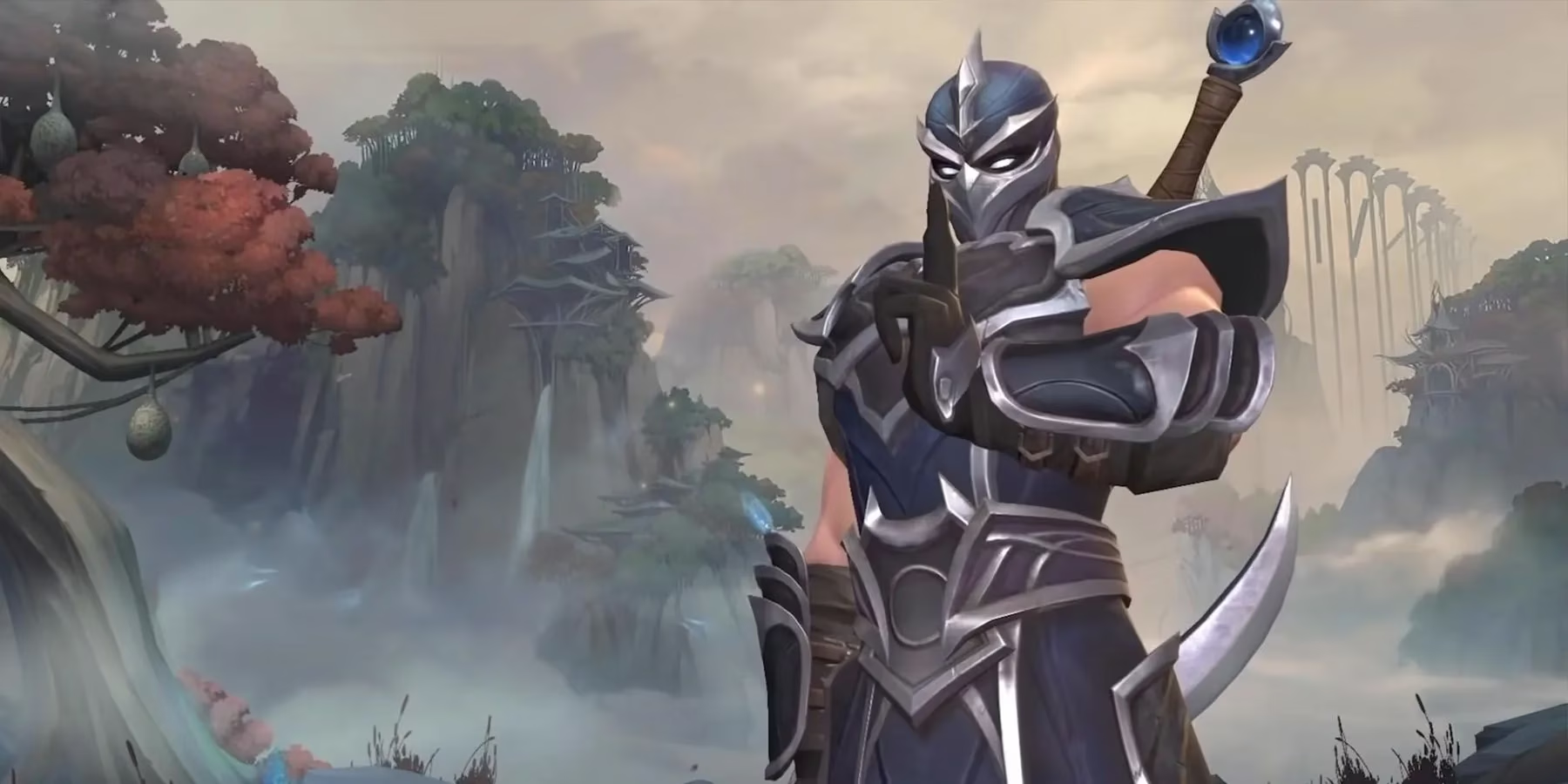
It was early 2026 when a veteran League of Legends: Wild Rift player logged in for another ranked match, only to notice how the game’s landscapes shifted mid‑battle — a towering infernal wall here, an ocean drake’s blessing there. The seamless dynamism felt natural now, but he still remembered when such a thing seemed impossible on mobile. To understand how far the game had come, one had to travel back four years, to the spring of 2022, when Riot Games unveiled Patch 3.1, the update that didn’t just tweak numbers but redefined the very soul of mobile MOBA.
The development team, led by executive producer Alan Moore, broke the news through a video update that felt like a town hall for the growing community. Moore’s voice carried both pride and urgency. He praised the team’s work on improving stability and latency — data showed smoother framerates and fewer disconnects across iOS and Android devices. Yet he also tackled a painful truth: no algorithm could fix a teammate going AFK in the middle of a crucial teamfight. The patch promised harsher, more transparent penalties. Suddenly, griefers weren’t just vanishing; they faced escalating bans and their victims finally saw the consequence. Could this finally be the patch that made climbing the ranked ladder feel fair? Many players dared to hope.
But the update’s beating heart was the Elemental Rift. Before 3.1, Summoner’s Rift on mobile remained a static map — reliable but predictable. The new system shattered that monotony. Once a match began, the terrain itself would listen to the dragons. When the Infernal Drake was slain, walls crumbled and pathways opened, forcing aggressive flanks. The Mountain Drake thickened certain corridors and spawned extra brush, favouring tacticians over button‑mashers. The Ocean Drake flooded sections of the jungle, slowing rotations and rewarding those who mastered map awareness. Now ask yourself: how many mobile games dared to physically reshape the battlefield mid‑game? The answer was almost none, and that was precisely the point. Riot wasn’t porting a PC feature for the sake of it; they were challenging the mobile audience to think like pros.
New items arrived to support this strategic depth, and older ones were rebalanced to stop the stale build paths that had plagued earlier seasons. A tank could now adapt to a sudden Ocean drake by itemizing for sustained fights, while an assassin facing Infernal terrain needed to gamble on pure lethality. The patch notes read like a chess manual — every change had a counterplay, every buff a vulnerability. Yet what truly captured community imagination were the scheduled events and collaborations. Riot teased crossover content with the PC version of League of Legends, bringing beloved themes and limited‑time modes to Wild Rift. Cosmetic‑hungry players drooled over upcoming skin lines that would let them dress champions like Ahri or Yasuo in exclusive styles only available on mobile. The patch didn’t just deliver features; it sold a fantasy of belonging to a living universe.
However, not all news from Alan Moore’s video sparkled with hope. The console versions of Wild Rift and the South Asian release remained in purgatory. Moore’s voice grew somber as he acknowledged the immense anticipation — and then delivered the blow: no updates would come in 2022. “We appreciate your patience while we’ve been working through these,” he said, leaving players to wonder whether the promise of cross‑platform play would ever materialize. That silence stretched across the rest of the year, a lingering question mark in the game’s otherwise meteoric trajectory.
Looking back from 2026, those delays feel like ancient history. The console port did eventually launch — though the exact timing varied by region — and Wild Rift now welcomes players from every major platform. The South Asian servers went live, unleashing a wave of talent that reshaped the competitive meta. But none of that growth would have been possible without the foundation laid by Patch 3.1. It was the moment the game stopped chasing its PC sibling and started leading with a mobile‑first identity. The Elemental Rift taught players to expect chaos and adapt on the fly; the fairness systems rebuilt trust in ranked play; the constant cadence of events proved that a live‑service mobile MOBA could be just as deep as its desktop cousin.
So here we are in 2026, watching new drake types and even more radical terrain experiments come to Wild Rift. The question that once lingered — “Can mobile gaming truly be a competitive powerhouse?” — has been answered not just with a “yes,” but with a roar that echoes across three elemental dragons. Riot didn’t merely ship a patch; they planted a philosophy. And for the millions who now consider Wild Rift their main game, the journey really did begin with that one spring update, when the ground beneath their champion’s feet became unpredictable, beautiful, and utterly their own.