Rengar has always been one of those champions who walks a razor’s edge between exhilarating and exasperating. For years, the Pridestalker was like a finely crafted Swiss Army knife that inexplicably came with only a single blade—his burst damage. If he could delete a carry inside his combo, he was a terror; if not, he offered all the utility of a damp cloth. That binary nature made him a balancing nightmare, and players on every side of the match felt the sting. Back in 2022, Riot finally addressed this tension with a surgical rework that reshaped how the hunter prowls Summoner’s Rift.
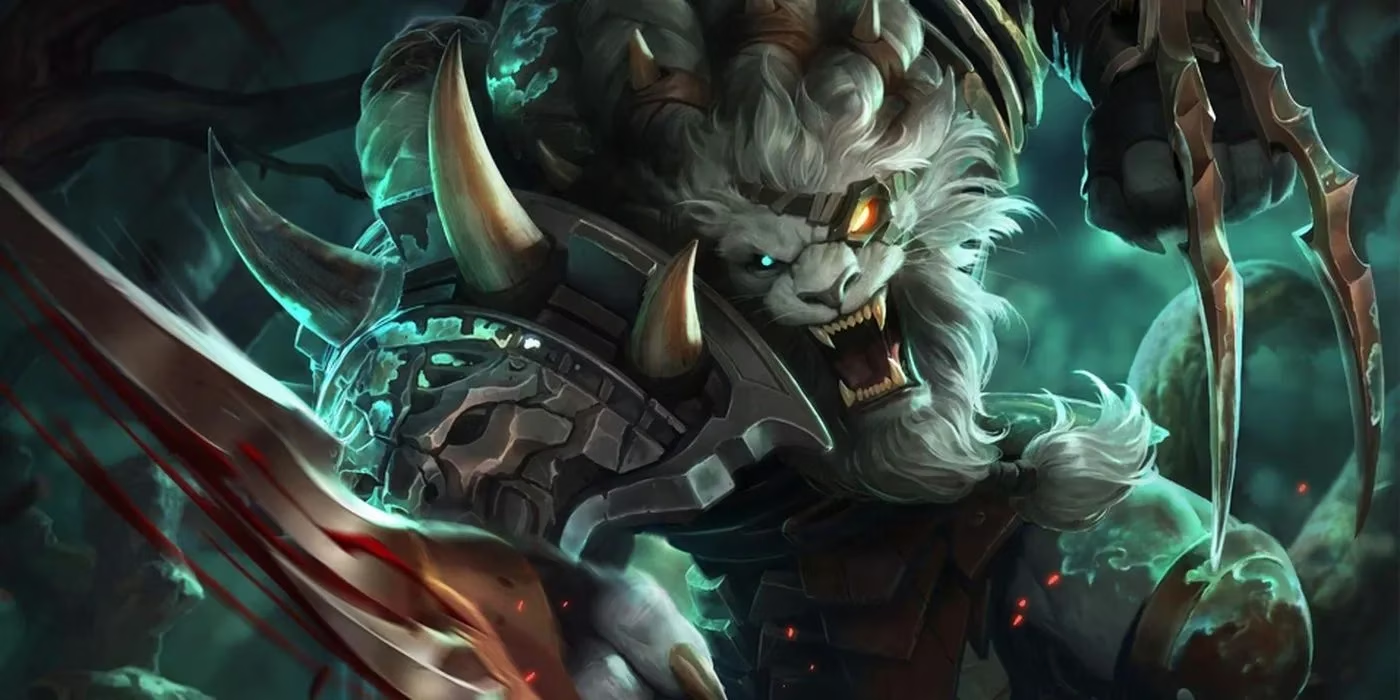
The core problem was never just about numbers. Rengar’s kit had minimal crowd control, conditional mobility, and an escape tool that doubled as his sustain. His Battle Roar could cleanse him and heal, and the empowered Bola Strike could briefly root a target, but these were thin threads of usefulness. The champion was like a clockwork predator that only ticked when it could land the killing blow; otherwise, the gears seized and the whole contraption became dead weight. Without sufficient damage, Rengar couldn’t peel, couldn’t soak, and couldn’t zone—he could only offer a hopeful stare from a bush. Conversely, when he had enough items to one-shot, his victims often felt there was no counterplay, vanishing from fog of war before a single ability could be fired back.
Designer Phlox shared the plan on Twitter, acknowledging that waiting for a perfect, sweeping rework wouldn’t do justice to players who wanted relief right away. The changes, which landed around Patch 12.6, were a series of thoughtful nudges rather than a full-blown overhaul. The first and perhaps most celebrated fix was the removal of that frustrating grace period where Rengar could sometimes leap from a brush even a split second after leaving it. This interaction was notoriously inconsistent; it felt like the brush clung to his fur for just a moment longer than it should, teasing both the player and the target. As compensation, the base leap range was increased by 25 units at all times, making it slightly more forgiving to close the gap without relying on that phantom brush-vision trick.
Another clunky piece of his kit was the cast time on Bola Strike when used mid-air. Previously, Rengar had to carefully weave his abilities to avoid animation locks that could cost him a kill. The rework allowed him to toss his bola during the leap without a pause, making his airborne combos flow like a cat mid-pounce on a laser pointer—fluid and uninterrupted. It was a small change that dramatically smoothed out his assassination pattern.
Rengar’s ultimate, Thrill of the Hunt, also received a clever utility upgrade. Instead of only revealing his target, the ability began to briefly illuminate a small area around the marked enemy. Think of it as the predator suddenly gaining a thermal scan of the prey’s immediate surroundings—he could now spot the support hiding just out of sight, the jungler lying in wait, or the whole team huddled together ready to collapse. This gave Rengar more informed decision-making power, nudging him away from the blind-dive-or-do-nothing loop.
The most statistically intriguing change was to Savagery, his primary damage ability. Before the update, building crit on Rengar introduced an element of dice-rolling, with his Q sometimes critically striking and sometimes not. After the rework, Savagery was always treated as a critical strike, and its bonus damage scaled linearly with critical strike chance. This removed the randomness that had plagued partial crit builds and, more amusingly, opened the door to spicy itemization like Navori Quickblades, which could now smoothly trigger its on-crit effects to reduce cooldowns. A hunter who can consistently weave his abilities becomes far more than a one-combo wonder.
In the months and years that followed, these changes proved to be more than a bandage. They gave Rengar a texture of reliability he had never known, softening the extremes that made him so contentious. While he never became a teamfighting jack-of-all-trades—and nor should he, as a dedicated assassin—his kit stopped feeling like a trap that only sprung in one wildly specific scenario. Players could now use his ultimate for genuine scouting, his leaps felt honest, and his damage curve was stabler.
Looking back from 2026, that Patch 12.6 rework stands as a textbook example of how to handle a champion stuck in a design cul-de-sac. Rather than reinvent the wheel, Riot focused on sanding away the pain points, adding a splash of utility, and then watching how the ecosystem adapted. The Pridestalker still thrives on the knife-edge of burst windows, but now he carries a little more than just a blade. He carries a plan.